GB
1949
1hr 28mins
Dirs: Sidney Cole, Charles Crichton and Basil Dearden
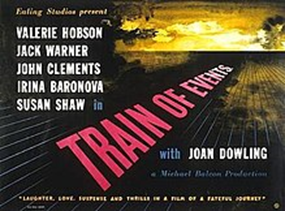
Starring: Jack Warner and Valerie Hobson
A train disaster is told as four short stories to give character studies of the people involved, how it will affect them, and how they deal with it
This was one of a series of ‘portmanteau’ films that appeared from various companies in post-war Britain in which a number of stories are all linked to a certain event, in this case a train crash. A large amount of fascinating railway footage was filmed for the production on the West Coast main line with a mixture of locomotives in both LMS and the then new British Railways liveries. The bulk of footage is split between departures from London Euston station, the section between Euston and the top of Camden Bank, Willesden Shed, and in the Home Counties around Bushey. The latter includes scenes at the water troughs with a very rare shot of a passing Bakerloo Line train of 1938 stock. Most of the footage was never used, and a lot appears hidden behind opening screen titles, although throughout the next two decades the odd shot would appear in other films that required a scene of a passing train, most notably The Gold Express (1955 qv). Indeed, all this footage has since been collected together and released by Video 125 in their Steam on 35mm DVD. The main locomotive in this film is ex-LMS rebuilt ‘Royal Scot’ Class 6P 4-6-0 No. 46126 Royal Army Service Corps (a loco that would go on to reappear in No Love for Johnnie -1961 qv). The ‘Royal Scot’ looks to be numbered ‘4612’ in some scenes, but closer inspection of the smoke box number plate in one shot shows this to be 46125 3rd Carabinier with the ‘5’ painted out (an odd attempt at continuity perhaps?). The loco hauls the doomed train which collides with a lorry on a level crossing, with the crash scene itself using models. Throughout the film many other locos are seen, but only a few can be readily identified. A number of other ‘Royal Scots’, both rebuilt and unrebuilt appear, along with Class 5XP ‘Jubilee’ and ‘Patriot’ 4-6-0’s, Class 7P ‘Coronation’ 4-6-2’s, Fowler Class 4F and Johnson 2F 0-6-0’s (the latter were an ex-Midland design that are rare in feature film), Fowler 2-6-4T’s, Class 5MT ‘Black Five’ 4-6-0’s, Class 8F 2-8-0’s and an ex-LNWR Class G2 ‘Super D’ 0-8-0. Of the ‘Jubilees’, three are identifiable in the form of No.s 45588 Kashmir, 45613 Kenya, and 5733 Novelty. Three Class 3F ‘Jinty’ 0-6-0T’s are also prominent in this film, No.s 47527, 47675, and No.47327 (the latter is referred to by Jack Warner as ‘Old Lizzie’ and has since been preserved). A Cravens Bros 50T Steam Breakdown Crane is also seen ‘on shed’ in several shots, including an excellent panoramic one of Willesden shed. It isn’t all LMS or Midland though as quite unintentionally there is a scene earlier in the film which sees two of the characters go to a flat in ‘Camden’. This overlooks the railway, and an express train passes by hauled by a streamlined Bulleid ‘Battle of Britain’ Class 4-6-2 in sunshine livery! This is not Camden, and will of course be somewhere on the Southern. On top of all this, Jack Warner’s house overlooks Westbourne Park station on the GWR out of Paddington, and a Pannier Tank and a ‘Castle’ can be made out passing through the station. There is also a scene filmed on the Underground with a train of Standard stock in the platform. It is not known where this sequence took place, but the entrance to Strand station is seen prior to the station’s rebuilding as Charing Cross and some of the deep level shots may have used this station. The entrance to Elephant & Castle Bakerloo Line Underground station on London Road appears earlier in the film whilst a couple of trams put in an appearance in the London street scenes, so all in all there is a wonderful mix in this film, with enough to interest everyone. It should be noted that the actual train journey is rather brief when compared with the rest of the film, and though there are some genuine shots onboard most of the journey uses a studio set with ‘back-projection’. Jack Warner agreed to take on the role as train driver, but only if it could be made as authentic as possible. As a result, he was given the enviable task of driving the express out of Euston, not very far and not very fast, but under tuition he got it moving without slipping. In those far off days of cinema, actors really were aloud full reign of the facilities on offer. However, not all was plain sailing as Warner was left with a painful reminder of this film when he overbalanced in one shoot and fell into a turntable pit, injuring his back and leg. The pain, and a slight limp, remained with him for the rest of his life – ironic when you consider that the film was about a train crash.
With regards to the cranes used in filming, and the location of the crash, its wrecakage, and the clear up operation, I receieved an email from Roger Cooke of the Brakedown Crane Association which I feel requires copying verbatim: “The first crane seen – at around 3m45s into the film – is Willesden’s Craven Bros Ltd 50 tonner built in 1931, one of two identical cranes built for the LMS, and unmistakable due to its lattice jib and distinctive shape. This crane was at the time of filming numbered RS1015/50 and was allocated to Willesden from 1939 until 1962. This crane is currently preserved at the Keighly & Worth Valley Railway and owned by the Bahamas Locomotive Society (it was used in the clear up of the Harrow & Wealdstone rail crash until it ‘broke’ and was replaced by a crane from Kentish Town – ed). I have not heard nor read anything to suggest that any scenes of the film were shot at Wellingborough, but I understand that the crash was staged at Wolverton Works. Wellingborough is not far north of Wolverton, and was probab;y the nearest significant shed with a breakdown crane at the time of filming, so it is possible either that the Wellingborough crane was used in connection with the staging of the crash at Wolverton, or that Wellingborough shed was used as a location since it was in the same general area as Wolverton. Incidentally, the only crane to be seen “in action” in the film, towards the end at the crash site, is not a breakdown crane at all and would never be used for the sort of work the film suggests it was undertaking. I suspect that this was Wolverton Works’ own yard crane, it appears to have a capacity of about 5 tons and would be wholly unsuited to accident work. The fact that this crane is seen in use suggests that RS1067/30 did not get used at Wolverton and that Wellingborough shed was used as the filming location.” This is of course all pure conjecture, but there is little real evidence to suggest that Wolverton was actually used though the glimpse of an ex-LNWR ‘Special Tank’ during the clear up operations suggests that it probably did, at least to some degree anyhow.